The Elderly Jewish Man at Foodtown
Today, I was in a rush for no good reason and ran through the Foodtown grocery store like a tornado. I had a 10 percent-off coupon, so my cart was jam-packed.
The store was short-staffed, so the checkout lines were long. My first thought was, “Of course, on the day I’m in a rush, the lines are long.”
I let three people go ahead of me because they had one or two items. My second thought was, “I guess I’m not in that much of a rush.”
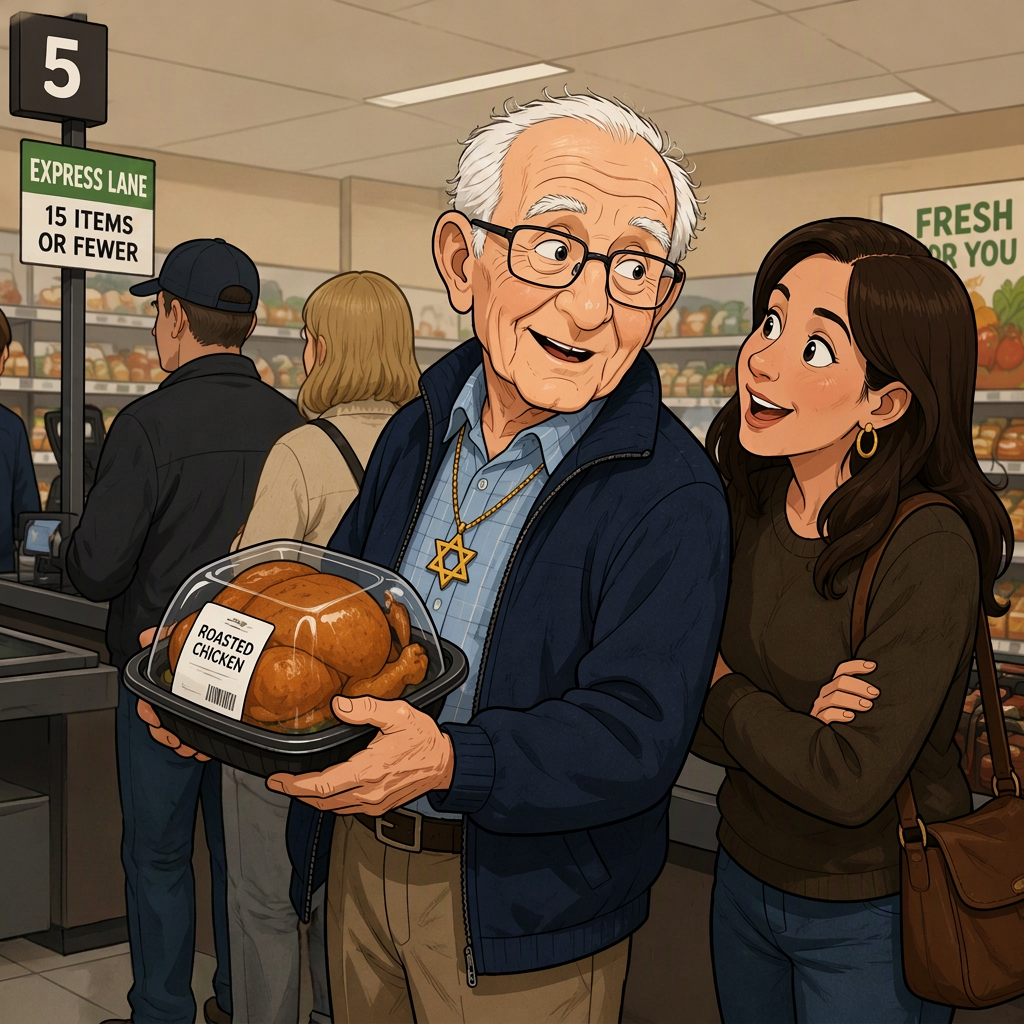
Right before the cashier began ringing me up, an elderly man shuffled up behind me, holding a roasted chicken and wearing a large Star of David.
“WAIT!” I yelled to the cashier, way louder than I had anticipated. So loud that some people in the other line turned around to see what the commotion at the local grocery store was about.
I gave them a Queens wave, then told the cashier, “Ring this gentleman up first.”
The elderly man smiled at me and said, “I saw you kindly let three people go before you. I figured three strikes…”
I answered without thinking. “You had me at your Jewish Star.”
As he checked out, he didn’t have a bag, so I gave him one of mine.
He told me that the star he was wearing was a replacement for the one recently ripped off his neck in New York City. He went on to explain that he was upset because his wife had given it to him, that she had recently passed away at 90, and that he was 91.
I replied that he looked great for his age, though that wasn’t entirely true. He was bent over and frail, and I figured he was in his 90s. Then I told him I was sorry he had to endure such anti-Semitic ugliness.
After he paid, he thanked me for my thoughtfulness and the bag, and wished me a “Shabbat Shalom.” I returned the wish for a peaceful Sabbath, a greeting many Jewish people exchange on Fridays.
I’ve been thinking about that old man all day.
I can’t get him out of my head.
When I told my husband, the son of Holocaust survivors, about my encounter with the elderly Jewish man at Foodtown, I asked him how people could be so despicable. He looked at me sideways and replied, “You still don’t get it?”
Yeah, I get it, but I still don’t understand it.
So I keep asking the same question over and over, hoping for an answer other than the one I already know.
JEW HATRED.
And yet, here I am, still asking.
WHY AND HOW COULD SOMEONE BE SO VILE AS TO RIP A JEWISH STAR FROM THE NECK OF A FRAIL, HUNCHED-OVER 91-YEAR-OLD MAN?
I’ve been asking myself and others WHY since October 7, 2023, and I’m so sick of asking the same old, heartbreakingly disappointing question.
BECAUSE I GET IT, BUT I DON’T WANT TO GET IT.
Boy George, whose career is probably over for daring to write a song defending Jews, put it best:
BEHAVE LIKE A HUMAN
Iranian Singer Sentenced to 74 Lashes
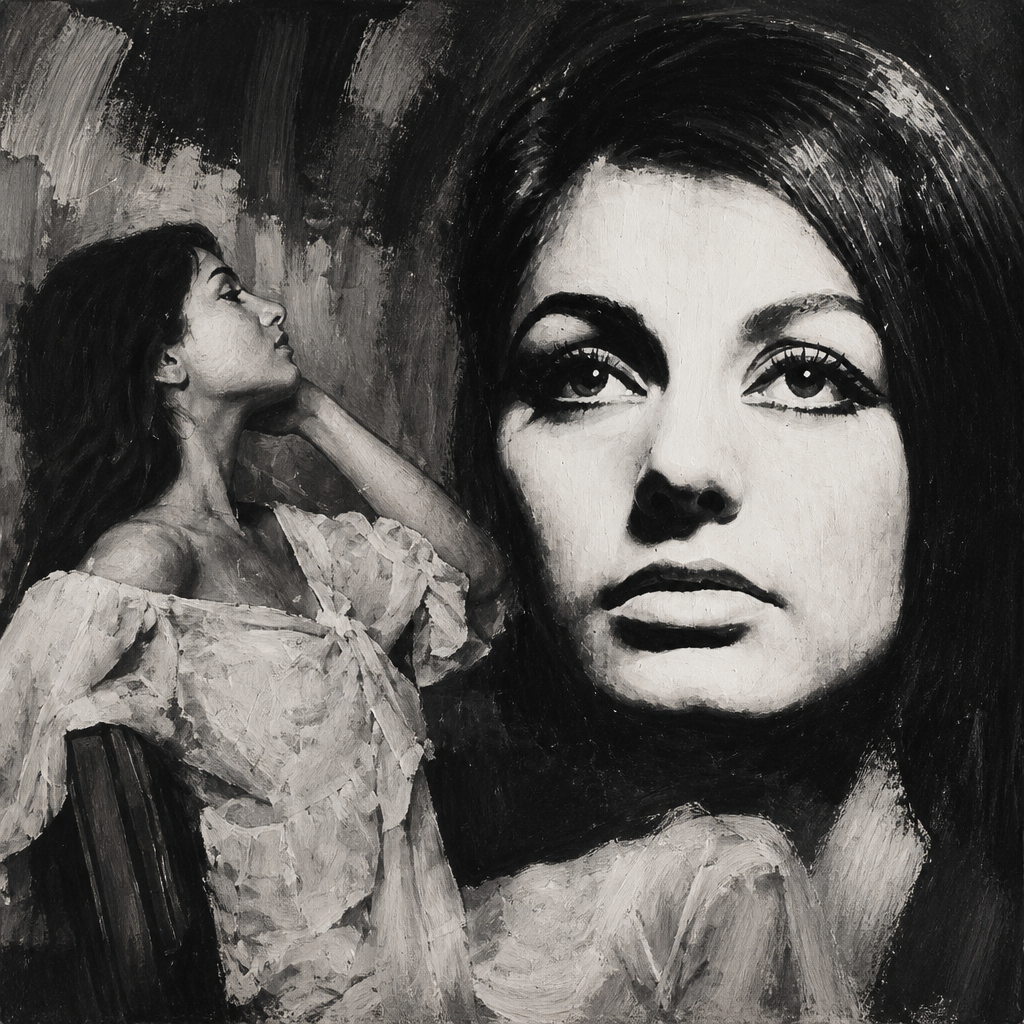
Parastoo Ahmadi (Left) and Googoosh (Right)
Iranian singer Parastoo Ahmadi was sentenced to 74 lashes for livestreaming an online concert without wearing a hijab. The severe ruling underscores ongoing restrictions on artistic expression and women’s rights in Iran.
The date of Ahmadi’s lashing, mandated by the Morality Police, has not been officially announced because her sentence is under appeal, though it is unlikely to be reversed.
The sentence, handed down on June 18, 2026, stems from a December 2024 livestream concert on Ahmadi’s YouTube channel. The 29-year-old Ahmadi sang a patriotic anthem without wearing a hijab, a practice banned under Iran’s strict laws.
In addition to the flogging, Ahmadi faces a two-year ban on leaving the country and a two-year ban on engaging in any artistic activities.
Fatemeh Shams, a professor of Persian Literature at the University of Pennsylvania, wrote on X: “Peace is not merely the silencing of missile sounds or the subsiding of bombardment flames. Peace finds meaning only when the bodies of women and innocent protesters are no longer fields for unrestrained violence; when whips, torture, and nooses are no longer tools of governance. True and lasting peace becomes possible only when no woman is branded a criminal for working, studying, singing, or choosing her own lifestyle; and when no innocent human is consigned to dark prison cells and gallows for the crime of protesting, demanding justice, or expressing an opinion.”
The Iranian-British actor Nazanin Boniadi said: “The sentencing of singer Parastoo Ahmadi to flogging for the simple act of singing publicly without a hijab is a stark reminder that, despite talk in Washington of a ‘new regime’ in Iran, the Islamic Republic’s machinery of repression remains unchanged.”
The Iranian actor Setareh Maleki, who was forced into exile after starring in Mohammad Rasoulof’s Oscar-nominated film The Seed of the Sacred Fig, said: “When I watched the video of Parastoo Ahmadi’s concert, it reignited the spirit of resistance in me. For days, I kept watching the videos over and over again, and I felt immensely proud of Parastoo.”
Since the 1979 Islamic Revolution, male singers face heavy censorship and must obtain official permits for public performances, while women have been prohibited from singing solo for mixed-gender audiences in public. Women are permitted to sing only in groups or choirs, or for female-only audiences. Singers must have their lyrics and music approved by the Ministry of Culture and Islamic Guidance, and the censorship and licensing process in Iran is highly stringent.
The sentencing of Ahmadi brought back memories of Googoosh, an Iranian Azerbaijani singer and actress who was wildly popular in the 1960s and 1970s.
Googoosh, a Turkish name meaning “Swan Bird,” was as famous in Iran as Elvis was in the United States.
Her music ranged from upbeat pop to emotional ballads, and she was often compared to Édith Piaf. Googoosh also starred in more than 25 movies, including the most commercially successful Iranian film of all time.
Then came the Iranian Revolution in 1979, which forever changed her life. During that time, 29-year-old Googoosh fled Iran and settled in Los Angeles.
For personal reasons, a few months later she returned to Tehran despite warnings that the incoming extremist regime would likely imprison or execute her. Upon her return, the new theocratic government arrested her, barred her from singing or performing, banned her music and movies, stripped her of her passport, and imposed a 21-year state-enforced silence on her.
During Mohammad Khatami’s presidency, after her 21-year sentence, she was somehow allowed to tour outside Iran. The Googoosh Comeback Tour was a series of concerts that began in July 2000, when she was 50 years old.
When I was the Publisher of World Press Review Magazine, I was offered press tickets to her historic sold-out New York concert at Madison Square Garden on August 26, 2000.
The concert scene was surreal as Googoosh was greeted by more than ten thousand cheering fans, many of them Iranian refugees who had last heard her sing in pre-revolutionary Iran and were openly weeping.
Googoosh has lived in exile and toured ever since, dedicating her life to keeping Iranian culture and music alive for audiences worldwide.
Oh, if only this was an option for Parastoo Ahmadi.
The Seven Minute Theory
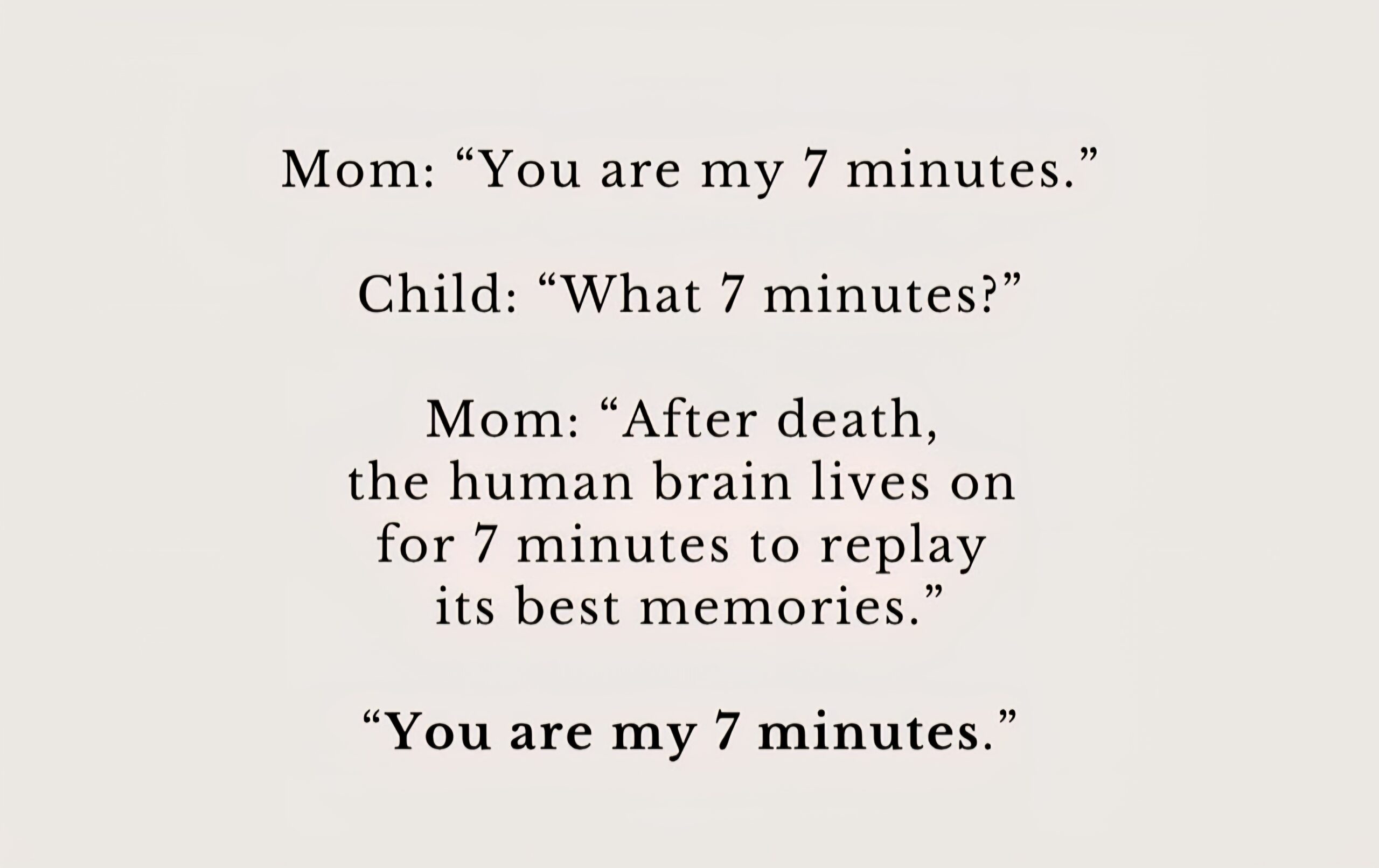
Yesterday, I came across the meme above, which suggests that the human brain remains active for about seven minutes after death, replaying its most cherished memories.
The meme tugged at me in a way I hadn’t anticipated.
Seven minutes.
What if my most treasured memories, people, or events could replay in my mind as I left this glorious earth behind?
An instant replay at death.
I found the concept cathartically soothing and deeply reflective.
Unable to get the meme out of my head, I went on my usual Google search-rampage for more information.
According to my research, the “seven minutes” phenomenon stems from observations of the dying process during near-death experiences. When the heart stops, blood and oxygen stop flowing to the brain, but neurons don’t die immediately.
Studies on animals and recordings from the brains of dying humans have shown brief, intense bursts of electrical activity, known as gamma waves, during the brain’s shutdown phase.
Some scientists have observed brief bursts of brain activity just moments after death, resembling patterns associated with memory or dreaming.
The “seven minutes” concept holds that this final surge of neural activity—caused by oxygen deprivation and a flood of neurotransmitters—can trigger a dreamlike state or sudden, vivid, and fragmented recall of memories.
Other scientists are adamant that a seven-minute duration is questionable, arguing that the brain retains residual electrical energy for less than seven minutes before irreversible damage occurs. Yet they also acknowledge that the duration can vary depending on the circumstances.
The bottom line? No one really knows.
Neural activity after death is an unfounded mystery, and there is no way to know whether the seven-minute instant replay claim is true.
I know nothing about the validity of consciousness during the dying process, but I was intrigued by the possibility.
There is no conclusive, hard scientific evidence that the brain remains alive for seven minutes or for any length of time after death.
Yet I couldn’t stop fantasizing about it.
And hoping for it.
For my purposes, and at my age, the mere thought that at death, instead of being terrified right before dying, there is a possible miraculous opportunity to experience pure joy for seven long minutes stuck with me as I tried to sleep last night.
In my final moments, I would love an instant replay of the people and the memories I cherish most.
Who wouldn’t?
Which then prompted me to ask:
If I had only seven minutes to relive the best moments of my life, which memories would I choose?
Whom or what would I see?
Whose laughter would I hear?
Who would be holding me close?
What memory would flash before my eyes in the fleeting minutes before I faded into the unknown?
Or maybe my seven minutes would be spent like Train’s lead singer Pat Monahan who wrote something unforgettably beautiful about his deceased mother in the song “Drops of Jupiter.” Monahan imagines his mother exploring the cosmos and the afterlife before coming back into his atmosphere with “drops of Jupiter in her hair.”
I was sleepless in New York, so I had countless hours to replay countless moments with countless precious somebodies in my head.
The idea of my brain replaying my best memories in those final moments before my death was as eerie as it was comforting.
I began instant-replaying some of my most glorious memories.
That night, we ran through the dark in R.I., then rolled around together in fits of laughter.
The one who loved snails and the one who preferred trucks and GI Joes.
The adoration in his eyes as we held hands and climbed the snowy hill to sled all the way down.
The way he pressed his beaming face against the boards of the ice rink when he saw me.
Her excitement as she told me that one of those adorable puppies was mine.
She preferred “DIAPES!”
Making roses together from tissues and a bobby pin.
Regrets, he had a few.
The goose poop was “everyway!”
The way she called out, “Teh? Teh?”
He was only one when he looked up at me as if no one else were in the room.
The saga of Pee Pants.
The big love I felt when he jumped into that puddle, which covered him in mud, and then he wrapped his arms around me ever so tightly.
Once upon a time, there was AAA.
I winced, but lovingly, as she hurdled over the pews at the prayer service, exposing her diaper-wadded tights.
How peacefully he slept in my arms for hours and hours.
The vow we made never to reveal what happened in the hotel room with all of us girls.
Our constant texting during Storm Sandy continued until both our phones died.
He was adamant about “Not even in a tunnel.”
Her French lilt as she lovingly called me “Mon petit chou.”
The laughter that poured out of the two of them as I raced them through the snow in the pitch-black night on that neon toboggan.
The way he comforted me when I was at my lowest point.
The dozen roses he bought me with all of his allowance money for Mother’s Day.
How she looked forward to my reading the newspaper to her every day after school.
That day, I washed my hair in the rain.
They were all part of my seven-minute moments, and I didn’t even have to die to recall any of them!
I thought about the treasured people who had passed through my life and the countless stupendously joyful memories, many of which I had long since forgotten.
And honestly, the memories were so vivid, and I felt so present. And, surprisingly, they didn’t make me sad. They made me ecstatically happy.
There were so many people I hadn’t thought of in years. Displaced moments, scattered memories—some so sweet that I was shocked I had forgotten them.
I relived times in my life that never made it into my highlight reel, even though many of those moments defined my entire persona.
A random meme about seven minutes of replay at death was the reason I spent all night reliving many of my favorite memories of so many people I loved and still love.
Then I started wondering…
I wondered whether so many of those I thought about last night will ever know how deeply I care about them.
And I vowed to tell as many as I could.
I wondered whether those who now exist only in a paradise I hope to one day join know that I think about them all the time and that they will always hold a special place in my heart.
I wondered about those who are still here but not with me—whether they know how much I love them and, if they do, whether they care.
I wondered whether I would someday be part of someone’s seven minutes.
If only.