I will warn you now that if you are faint of heart, do not read this blog.
And it’s long, but I didn’t even try to shorten it.
The story is too remarkable to whittle down, so this blog post is how I will honor Christmas this year.
Skim it if you must, but I am hoping you will not.
And at the end of this blog post is a YouTube video I hope you take the time to watch.
On October 21, 2019, I wrote a blog post about how, during the Armenian Holocaust, the Turks drove my paternal grandparents out of Syria.
During that harrowing time in my grandparents’ young lives, millions of Armenians, Assyrians, and members of other non-Muslim minorities were deported, starved, raped, kidnapped, and slaughtered.
I had no idea that my post about my Syrian grandparents would be read by so many thousands of people.
To be honest, I didn’t think anyone would care at all about what happened to them.
To my readers: Thank you for caring.
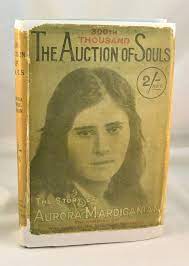
While working on the blog post, I discovered and ordered a book about the Armenian Holocaust written by a 16-year-old survivor, Aurora Mardiganian.
First things first.
Turkey continues to deny what historians have called the first genocide of the 20th century, and in Turkey, it is an actual crime to “insult Turkishness” by even raising the issue of what happened to the Armenians.
And the Trump administration backed Turkey up, arguing that if the U.S. ever recognized the Armenian genocide as a matter of foreign policy, such a resolution would damage the United States-Turkey relationship.
To be fair, many past administrations have disappointedly backed Turkey up.
On Thursday, December 12, 2019, the Senate, for the first time, voted unanimously to formally designate the 1915 mass killings of an estimated 1.5 million Armenians at the hands of the Ottoman Empire as a genocide.
Of the nearly 1.5 million Armenians killed, some were massacred, and others were forced to march to the Syrian desert where they were left to starve to death.
And then there were the women and little girls who suffered unimaginable violations, sold into Turkish harems, ravished by the roadside, crucified, and so much worse.
One of those young girls was Aurora Mardiganian, and her story will chill you to the bone.
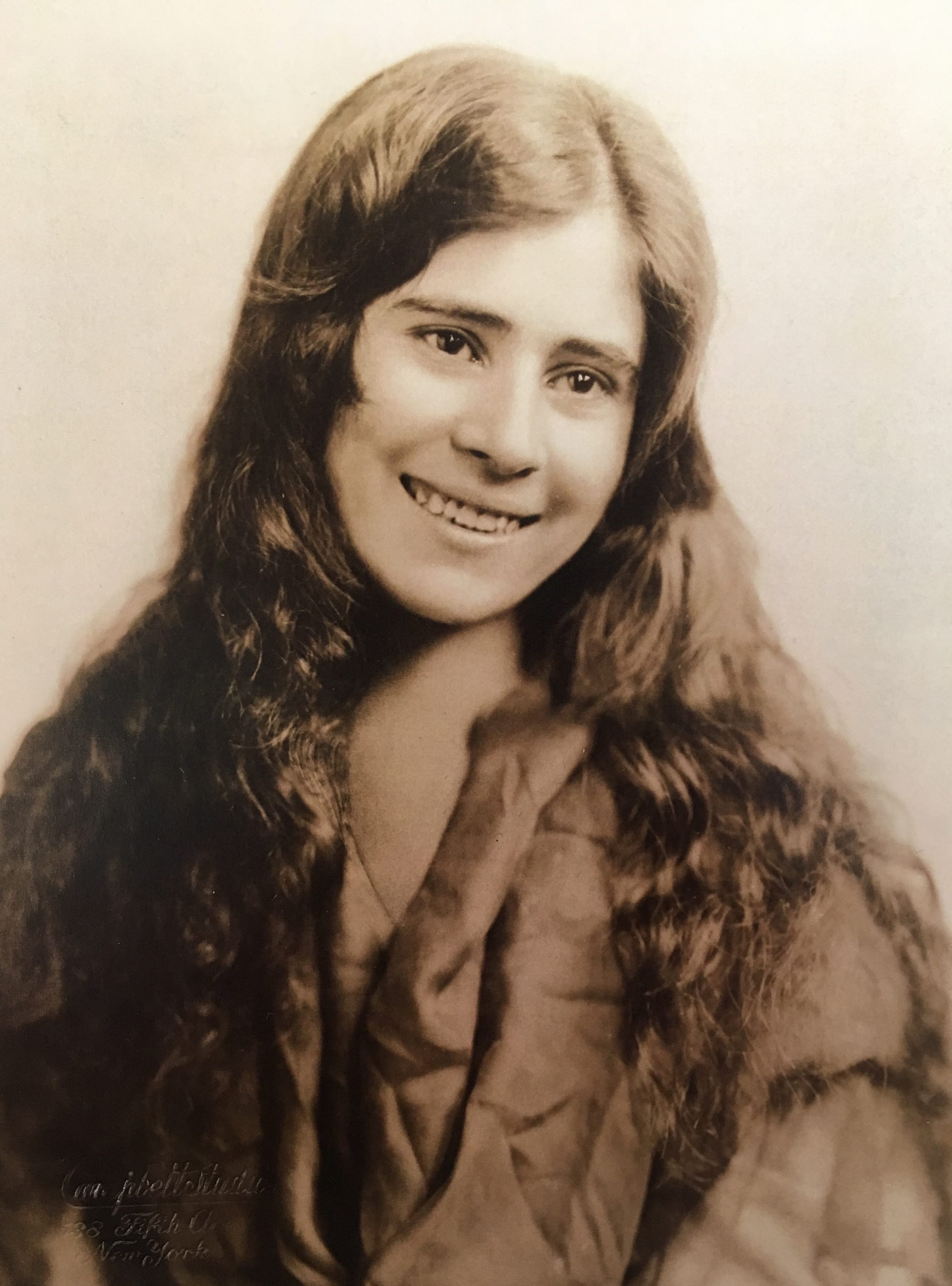
Aurora, born Arshaluys Mardiganian, in 1901, was the daughter of a prosperous Armenian family who lived in Ottoman Turkey, twenty miles north of Harput, a few miles east of the river Euphrates. The Turkish residents and the Armenians had been good neighbors.
That was until 1914, when at fourteen years old, she witnessed the deaths of her entire family, including watching as Turkish soldiers ripped open her pregnant aunt’s stomach with their bayonets, and trying in vain to save her older sister who was murdered as she resisted being raped. She was later forced to watch as her mother, and remaining siblings were whipped and stabbed to death.
Aurora, who was forced to march over 1,400 miles, was brutally raped, beaten, kidnapped, and sold into the slave markets of Anatolia.
Three years into her nightmare, she miraculously escaped, roaming through a region of nothing but desert, where she encountered many acts of kindness from the Dersim Kurds whom she described as people “without the lust of killing human beings…” and to them “she owed her life.”
After months of wandering through the desert, Aurora finally reached the Turkish city of Erzeroum, which was by then occupied by Russia. In her book, she recalled her arrival there and being greeted by “a beautiful sight—the American flag.”
She then made her way to Tiflis, which is now Tbilisi, Georgia, then to St. Petersburg. From there, she traveled to Oslo, and finally, with the assistance of an organization called the Near East Relief, she made safe passage to New York City and arrived at Ellis Island in 1917.
Soon after she arrived In New York, Aurora was approached by a young screenwriter named Harvey Gates, and he helped the then sixteen-year-old orphan write and then publish her memoir titled Ravished Armenia.
According to Gates, her work on the book was exhausting: “Sometimes there had to be intervals of rest of several days because her suffering had so unnerved her…You who read the story of Aurora Mardiganian’s last three years will find it hard to believe that in our day and generation such things are possible.”
Back in 1917, Gates found the Armenian Holocaust hard to imagine. But history has taught us that “such things” happen every day.
This is Aurora’s dedication from the book:
“To each mother and father, in this beautiful land of the United States, who has taught a daughter to believe in God, I dedicate my book. I saw my own mother’s body, its life ebbed out, flung onto the desert because she taught me that Jesus Christ was my Saviour. I saw my father die in pain because he said to me, his little girl, ‘Trust in the Lord; His will be done.’ I saw thousands upon thousands of beloved daughters of gentle mothers die under the whip, or the knife, or from the torture of hunger and thirst, or carried away into slavery because they would not renounce the glorious crown of their Christianity. God saved me that I might bring to America a message from those of my people who are left, and every father and mother will understand that what I tell you in these pages is told with love and thankfulness to Him for my escape.”
In 1919, the book was made into a silent film with the same title.
Referred to in the press as the Joan of Arc of Armenia, Aurora heroically played herself in the film. And the then Ambassador Henry Morgenthau played himself as the American Ambassador to Turkey.
As a survivor and eyewitness of the Armenian Holocaust, Aurora’s memoir heartbreakingly recalls the brutality, ugliness, and horror of genocide, and what occurred to the young girls and women as a result of male dominance, their sick sexual desires, and their inhumanity and hatred for Christians.
In one section of the book, Aurora witnesses sixteen young Armenian girls being crucified “on rough wooden crosses” by their Ottoman tormentors.
The film depicted the victims nailed to crosses, but in 1989, seventy years after the film was produced, Aurora confessed to the film historian Anthony Slide, that the scene was inaccurate. She painfully went on to describe what was actually vaginal impalement.
She stated that “The Turks made little pointed crosses. They took the clothes off the girls. They made them bend down, and after raping them, they made them sit on the pointed wood.”
The book depicts the cruelty of the Turks, but they weren’t the only ones with blood on their hands.
They allowed and orchestrated others to join in: The Chechens, the Kurds, and the Germans.
According to Aurora, all of the evil and wickedness perpetrated by the “bandits of the desert” was inspired by “their Turkish masters.”
She describes the Chechens as being more cruel and wicked than the Kurds and that during the massacres, the Turks gave them permission to steal as many Christian girls as they wished.
There was a section of Mardiganian’s book describing “The Game of Swords” played by the Chechens after they tired of raping the young women.
“They planted their swords, which were the long, slender-bladed swords that came from Germany, in a long row in the sand, so the sharp-pointed blades rose out of the ground as high as would be a very small child. When we saw these preparations all of us knew what was going to happen… Already I was trembling with sickness of heart because of the awful night before and the things I had seen that morning when daylight came. The other women beside me were trembling, too, and felt as if they would rather die than see any more. We begged our Tchetchens to take us away—to take us where we could not look upon those sword blades—but they only laughed at us and told us we must watch and be thankful to them we were under their protection.
When the long row of swords had been placed the Tchetchens hurried back to the little band of Armenians. We saw them crowd among them, and then come away carrying, or dragging, all the young women who were left—maybe fifteen or twenty—I could not count them.
Each girl was forced to stand with a dismounted Tchetchen holding her on her feet, half way between two swords in the long row. The captives cried and begged, but the cruel bandits were heedless of their pleadings.
When the girls had been placed… one between each two sword blades, the remaining Tchetchens mounted their horses and gathered at the end of the line. At a shouted signal the first one galloped down the row of swords. He seized a girl, lifted her high in the air and flung her down upon a sword point, without slackening his horse. It was a game—a contest!
Each Tchetchen tried to seize as many girls as he could and fling them upon the sword points, so that they were killed in the one throw, in one gallop along the line. Only the most skillful of them succeeded in impaling more than one girl. Some lifted the second from the ground, but missed the sword in their speed, and the girl, with broken bones or bleeding wounds, was held up in the line again to be used in the “game” a second time—praying that this time the Tchetchen’s aim would be true and the sword put an end to her torture.”
Another section of the book describes the sick cruelty of the Kurds as told to Aurora by Margarid, the wife of a pastor about the rape and murder of her six daughters, including her oldest daughter Sherin, who was fourteen:
“There were a thousand of us,” Margarid said when we had brought her out of the stupor of grief which had overcome her… The first night Kurdish bandits rode down upon us… They stripped all the women and children — even the littlest ones… They took all the pretty girls and violated them before our eyes… When we left the Kurds and [Turkish] soldiers who were tired of the girls were killing them. …the soldiers killed my little ones by mashing their heads together. They violated Sherin while they held me and then cut off her breasts, so that she died.”
Aurora wrote much about the cruelty of the German soldiers and how they armed and taught the Turks how to use machine guns. The Germans would lead the Turkish soldiers personally and helped to raid and machine gun Armenian houses.
There is one particularly disturbing section of the book that describes the evil of the German soldiers:
“Late in the afternoon the chief of our Tchetchens came out from the city. His men drew off to one side and talked with him excitedly. When it grew dark they lifted us upon their horses and carried us into the city through the south gate. At the gate the Tchetchen chief showed to the officers of the gendarmes a paper he had brought from the city, and the Tchetchens were permitted to enter. We passed through dark narrow streets until we came to a house terraced high above the others, with an iron gate leading into a courtyard off the street. A hammal, or Turkish porter, was waiting at the gate and swung it open.
The bandits dismounted outside the gate to the house and lifted us to the ground. The leader waved us inside. With half a dozen of his men he entered behind us and the gate closed. Some of the Tchetchens went into the house. In a few minutes they came out, followed by a foreign man, whose uniform I recognized as that of a German soldier.
Servants followed with lighted lamps, and the soldier looked into our faces and examined us shamefully. Only eight of the girls pleased him. I was among these. We were pushed into the house and the door was closed behind us. Then we heard the Tchetchens gather up the other girls and take them into the street. I do not know what became of them. The soldier and the servants, all of whom were foreigners, whom I afterward discovered were Germans, took us into a stone floored room which had been used as a stable for horses.
It must have been two or three hours afterward—after midnight, I think; we could not keep track of the time—when the soldier and the servants came for us. Before they took us from the stable room they took away what few clothes we had. They led us, afraid and ashamed, into a room where there were three men in the uniforms of German officers. The soldiers saluted them. The officers seemed very pleased when they had looked at us. We tried to cover ourselves with our arms and to hide behind each other, but the soldier roughly drew us apart. The officers laughed at our embarrassment, and then dismissed the soldier, saying something to him in German, which I did not understand.
The officers talked among themselves, also in German. They tried to caress us. It amused them greatly when we pleaded with them to spare us, to let us have clothes and to have mercy, in God’s name.
Almost two weeks I was a prisoner in this house… To this house were brought many pretty Armenian girls stolen by the Kurds and Tchetchens. When they tired of them they sent them away to the refugee camps outside the city or to be sold to Turks.
There was another girl, who had been a prisoner in the house longer than others—since before I was taken there. She had especially pleased one of the under-officers. She told me of one night when the officers had taken much of their whiskey and were particularly cruel. She said they sent for some of the girls then in the house and, standing them sideways, shot at them with their pistols, using their breasts as targets.”
During the days I spent reading Aurora’s book, it was difficult to sleep at night. I would lay awake and ask myself if I could have survived. I honestly don’t think so.
With every word I read, it was unfathomable how one young girl could have witnessed and experienced so much brutality, so much grief, and still come out on the other side.
And yet through all of the torture, the misery, the agony, hope and faith endured.
In Aurora’s words: “But always there was hope of deliverance. So many Armenians had friends in America, sons and brothers who had left our country to go to the wonderful United States. They prayed every night that from America would come help before all were dead… It was this hope that kept thousands alive.”
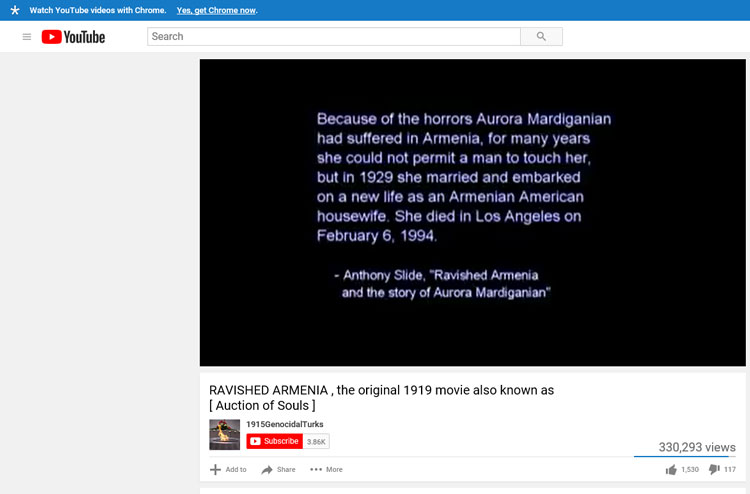
Aurora ultimately married a fellow survivor in 1929, had a son and lived in Los Angeles until her death.
In 1994, Aurora spent the last few weeks of her life at a nursing facility in the San Fernando Valley. On February 6, 1994, she died alone at Holy Cross Hospital at age 92. At the time of her death, she was estranged from her son. Her body went unclaimed, and she was cremated and buried anonymously in a mass grave somewhere in Los Angeles.
Aurora is long gone, but I sincerely hope that she will never be forgotten.
Her life and legacy highlight the importance of action over apathy and compassion over indifference.
Like many films made during the silent era, Ravished Armenia was lost.
There are some who say that that the disappearance of the film was the result of a Turkish conspiracy.
All that is known to be left of the film is 18 minutes of poorly preserved footage, which was discovered in a trash bin.
Please watch the film footage, and in honor of Aurora, never forget.