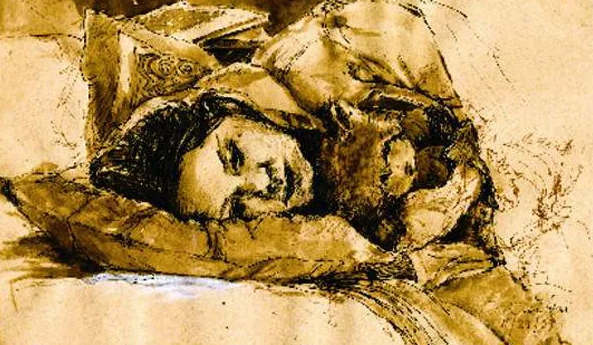
I had three dreams this week, but I only remembered one sentence from each.
After each dream, the process was the same: I awoke, said the sentence aloud, and then scribbled it down in the dark.
February 23: Stuck in the valley of no.
February 25: She looked beyond all of it and said goodbye.
February 27: But the girl is always in there.
As I read and reread the three sentences this morning, I concluded that, in addition to dreams, they were also a collection of ideological musings and a dialogue between my conscious and unconscious mind.
Which got me thinking about Sigmund Freud, Carl Jung, and Teri Schure’s theories on dreams.
In the early 1970s, I bought a used copy of Sigmund Freud’s The Interpretation of Dreams, a 1955 English translation. I have read and reread it countless times and still consult it whenever I analyze a dream.
The book, published in 1899, examines why we dream and why dreams matter in our psychological lives. In it, Freud presents his theory of the unconscious mind through dream analysis, arguing that dreams are disguised fulfillments of repressed wishes, often originating in the personal, repressed unconscious rooted in childhood experiences. Freud distinguishes between the manifest (remembered) and latent (hidden) dream content, using dream interpretation as a key to understanding the unconscious.
A few years after buying Freud’s book, I bought Man and His Symbols by Carl Jung. In his book, Jung argues that the world of the unconscious mind is as vital and as true a part of us as the conscious mind, and that both communicate through our dreams—those personal, integral expressions of our deepest selves.
Jung’s book and theories differ from Freud’s in that the concept of the unconscious mind, as revealed through dream analysis, has nothing to do with repressed desires or wishes.
According to Jung, dreams are unvarnished, spontaneous, and random messages from the unconscious that aim to balance the psyche, promote wholeness, and serve as a counterweight to the conscious mind and its attitudes. As such, dreams serve as a vehicle for communication and can help the dreamer integrate the conscious and the unconscious. This process involves accepting, respecting, accommodating, and learning to live in peace with both our conscious and unconscious selves.
Freud believed that dreams served as a façade, concealing deep, dark, suppressed secrets. Freud’s approach focused on past events from the personal unconscious and aimed to decode or make sense of repressed trauma. Freud also believed that dreams have a direct connection to past experiences.
Jung believed dreams were future-oriented, direct, and honest representations of the unconscious and that they provided fodder for conscious attitudes and were instrumental in resolving and balancing unfinished emotional issues.
I found the diverging opinions between their genius dream theories, as well as the personal relationship between Freud and Jung, fascinating.
When they first met in 1906, Freud, nearly twenty years older than Jung, was already well established and regarded as the “king” or “father” of psychoanalysis.
Born in 1856, Freud was the established mentor, while Jung, born in 1875, was considered the younger, rising colleague—often referred to as the “crown prince” or “son” of psychoanalysis.
Because of the age difference, their relationship often mirrored a father-son dynamic until their professional split around 1913, after which they never spoke again, leading to the development of two distinct schools of thought.
Jung felt that Freud’s emphasis on sexuality was too narrow and limiting. Rather than merely masking repressed desires, Jung believed that dreams used symbolic language to reveal personal truths, highlight mental and physical health issues, and offer guidance.
Freud respected Jung’s intellect but was annoyed by his refusal to serve as a “rubber stamp” for Freud’s theories. Some theorists argue that Freud and Jung parted ways because of homosexual feelings that destabilized their relationship.
I have always been skeptical of the reasoning behind Freud and Jung’s view that their theories were irreconcilable. So perhaps it is no surprise to me that the why and how of my dream process include elements of both theories.
There is a concept called “unfinished thoughts,” which is another theory about repressed (unconscious) and suppressed (conscious) memory. Every time our brain tries to repress or suppress intrusive thoughts, lingering worries, traumatic experiences, or anything the conscious or unconscious mind has not resolved, those experiences are encoded in memory. These memories and unwanted thoughts we try so hard to suppress and repress often resurface in our dreams, a phenomenon known as “dream rebound.”
Like Sigmund Freud, if I wake from a dream and remember it, I write it down so I can later try to make sense of its meaning, and I always add it to a Word document titled “Dreams” on my computer. On one eerie occasion, I had an immensely troubling nightmare, only to learn months later that someone I once loved had passed away on the same day I had the dream.
Like Carl Jung, I believe that my conscious and unconscious are distinct yet interacting parts of a single, unified psyche. I also believe that my dreams are messages from my unconscious that often influence my conscious life.
My dreams are complex and detailed and seem to last for hours, even though I know most dreams typically last between five and thirty minutes, and that it is possible to have four to seven dreams per night.
When my dreams aren’t long and drawn out, they often manifest as a single sentence. Or maybe they are long and drawn out, but when I wake up, the only thing I retain is a one-liner from the dream.
Here are some key concepts I have learned from Jung and Freud, along with my own repressed, suppressed, and unfinished thoughts about dreams:
- My dreams often serve as a window into my unconscious mind, revealing my repressed hopes, desires, fears, and conflicts. My daytime rumination about stressful, negative, or unfinished life events manifests in my sleep.
- Some of my dreams, disguised as fulfillments of my unconscious, repressed thoughts and memories, are often violent and aggressive. Thoughts I have intentionally and consciously suppressed or blocked out during the day tend to haunt and taunt me in my dreams.
- My dreams are a continuation of my waking thoughts, in which my attempts to resolve, process, or make sense of unpleasant situations remain unfinished.
Like Freud, I believe my dreams often reflect my childhood experiences and help me process unmet emotional needs, anxieties, or traumas that were never properly addressed. For Freud, the truest interpretation of a dream must help the dreamer uncover hidden, repressed, and usually infantile wishes.
Like Jung, I believe my dreams often contain powerful, universal symbols that directly relate to my current life, emotions, and waking situation, and that they bridge the conscious and unconscious. For Jung, the truest interpretation of a dream must help the dreamer move forward in their life and personal development.
Circling back to the three sentences from my dreams, I see more clearly what they are trying to tell me. I also recognize distinct elements in them that Freud and Jung strongly believed in.
And when I put my three dream fragments together, they make all the sense in the world, from both a conscious and unconscious perspective:
Stuck in the valley of no, she looked beyond all of it and said goodbye. But the girl is always in there.