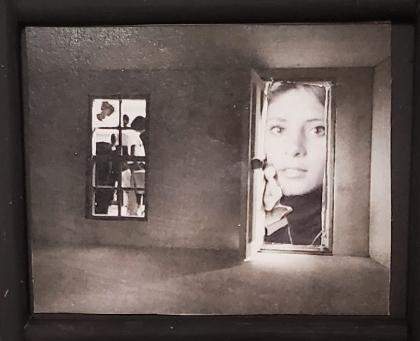
When I pressed “send,” 5,000 words of my 12,346-word manuscript, The Dollhouse Chronicles, were included in a required package due this past Sunday, ahead of a writing mentorship masterclass I am invited to attend in April.
I was both relieved to meet the deadline and deeply gratified that my book—a novel I have been working on for over two years—was finally put to bed.
But that night, after already sending off my submission, I woke before daybreak from a dream, or maybe it was my subconscious telling me that The Dollhouse Chronicles had not yet been “put to bed.”
Whatever it was, it showed me one of my female characters barefoot. When I sat up, I silently cursed myself for not adding that all-important detail to describe her fleeing a harrowing situation. Of course, she was barefoot.
I charged down three flights of stairs and opened The Dollhouse Chronicles Word doc. I added the word “barefoot” to the end of the second-to-last sentence of a narrative-driven flashback in chapter five. Though labeling it a chapter is nowhere near an accurate description of the gut-wrenching scene.
I’ve been struggling to capture the sections of my book in a way that is laudable and meritorious. The narrative breaks involving the three main girls in my manuscript deserve a poetic description worthy of their gritty characters and thriving spirits, not a rote label like “scenario,” “chapter,” “scene,” or “episode.”
Those three young ladies deserve a description that is far more visceral and evocative—something that does justice to their resilience, courage, and resolve.
And then it hit me.
I could call each section a vignette, a fitting and descriptive homage to the three powerhouse characters in my book. Wait. Had I just created a subtitle for my upcoming novel?
THE DOLLHOUSE CHRONICLES
A Collection of Vignettes
Yes. My three heroes were part of a collection of vignettes, and just like that, my book had a new title. However, I’ll wait to review it with my writing adviser before making the change.
And then came night two after my submission—and nights three and four.
Those nights were chock-full of vivid, intricate, multifaceted layers that clearly needed to be woven into my already-completed novel.
Each night, I jotted down the myriad visions, and each morning I added them to my manuscript.
This book, which I thought was finished, seems to have taken on a life of its own—morphing, developing, and rewriting itself.
And it’s obvious from the reams of notes I’m taking and making that I’m not finished with the manuscript because the manuscript is clearly not finished with me.
And so, I’ve been listening to the novel and updating what it wants me to say.
It feels ridiculous to say I’m listening to a novel. That, as the writer, I’m not in charge of my own words. Is that even possible?
I say yes.
The words flow easily and connect so fluidly that I know beyond a doubt that my book is in control.
And now The Dollhouse Chronicles is transforming itself day by day through vignettes.
The rich complexities of the characters in my trauma-based novel continue to reveal themselves in endless, intricate detail. My novel has proven itself to be a work in progress. Just like me.
UPDATE AS OF MARCH 6, 2026: I just watched the trailer for Hulu’s The Testaments, a highly-anticipated spin-off of The Handmaid’s Tale. The trailer opens with a new character, Agnes, who says she isn’t sure what year it is but knows she still has her dollhouse. Agnes says her dollhouse is just like her real house—filled with dolls, always busy, doing important work— but the little girl doll is her—back when she still believed in the world. The dollhouse in The Testaments symbolizes the characters’ dollhouse-like existence, emphasizing the stark difference between their idealized world and the brutal reality they confront.
The dollhouse in The Testaments serves as a reminder of the power of imagination and the potential for resistance against traumatic events, the exact theme of my book. Just so I’m clear here, I came up with the concept first!
Watch The Testaments trailer here.